It is difficult to imagine Uzbek culture without the skullcap — doppi. Today, this small traditional headwear item is one of the most recognizable symbols of Uzbekistan. It is worn by men and women, adults and children, as part of traditional dress and festive attire.
Although similar skullcaps can be found among various peoples of Central Asia, as well as in Turkey, Azerbaijan, Tatarstan and other regions, the skullcap has developed a distinctive character in Uzbekistan. The variety of shapes, fabrics and embroidery has turned it into a unique form of folk art.
How Did the Skullcap Originate?
The exact origins of the skullcap date back to ancient times. One theory links it to Turkic nomadic peoples. It is believed that an early predecessor of the modern skullcap may have been a felt under-cap worn by warriors beneath metal helmets to protect the head.
As the lifestyle of nomadic peoples changed, the skullcap gradually lost its military function. The headwear itself survived but came to be used in everyday life.
The origin of the name is associated with the Turkic words “tyube”, “tope” and “tobe”, referring to the upper part or top of something. Modern skullcaps vary considerably in appearance: they can be round, square, flat, tall or cone-shaped.
What Do the Patterns on a Doppi Mean?
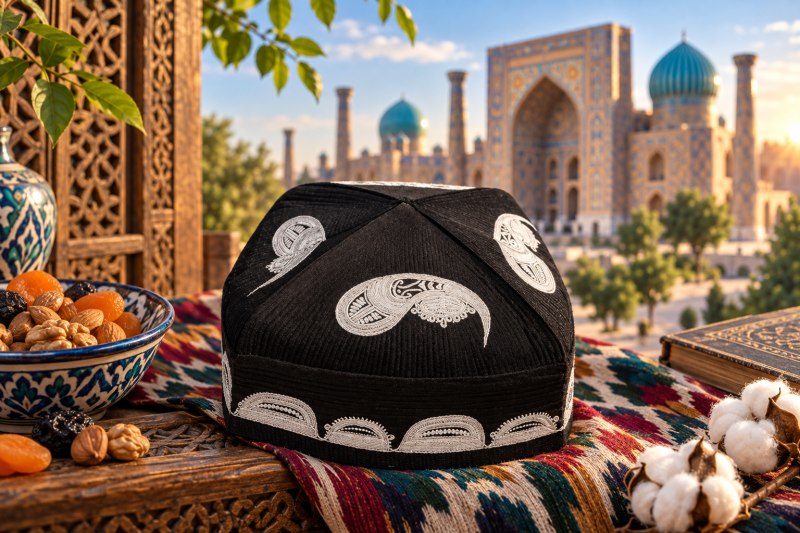
The most recognizable version is the black-and-white, four-sided doppi. Traditional skullcaps are decorated with hand embroidery, with individual motifs carrying their own symbolic meanings.
One of the most widespread motifs is “bodom”, an almond-shaped pattern traditionally associated with fertility and protection. The ornaments are arranged in a way that symbolically protects the wearer from all sides. The almond motif is particularly characteristic of the famous Chust-style skullcap.
The lower section of some skullcaps is also decorated with distinctive motifs. Here, 16 arched elements can be seen. A small arch featuring a cradle is associated with the beginning of new life, while a larger arch is linked symbolically to the end of the human journey. Together, these elements form a symbolic narrative of human life.
When Is the Skullcap Worn?
In the past, the skullcap also held an important place in religious traditions. Today, it can be seen during prayer, visits to mosques, religious holidays, weddings and mourning ceremonies.
The skullcap also has a special place in Uzbek wedding traditions. A traditional headwear piece may form part of the groom’s attire, as well as that of his father.
Over time, the doppi ceased to be considered exclusively a men’s accessory. Women’s skullcaps emerged, distinguished by bright colors, intricate patterns and rich embroidery. Bukhara is particularly renowned for its skullcaps decorated with gold thread.
Today, the skullcap continues to thrive in contemporary Uzbek culture. This small piece of headwear brings together the history of the Uzbek people, the craftsmanship of embroiderers, national symbolism and traditions, preserving a connection between generations.
 Русский
 Français